February 16, 1950
Briefly explains the belief that President Truman’s civil rights program would fail in Congress.
February 16, 1950
Briefly explains the belief that President Truman’s civil rights program would fail in Congress.
February 19, 1948
Explains that southern Democrats were displeased with President Truman’s proposed civil rights legislation and that they planned to protest its progress, as well as the northern Democrat’s decisions, at the Democratic National Convention.
February 20, 1964
Explains the belief that free speech was denied when President Maguire of Loyola University denied Governor Wallace the ability to speak on campus due to the belief that it would offend the Black community.
February 23, 1950
Describes that the Senate pushed back voting on President’s Truman’s FEPC anti-discrimination bill and explains that the bill would implement measures to prevent racial or religious discrimination when employing or firing workers.

February 25, 1965
February 26, 1948
Describes that an investigation was being conducted after a Black woman named Mamie Peterson filed charges of rape against two white men.
February 26, 1948
Describes the disputes between southern governors and the national Democratic party as President Truman pursued a civil rights program and the impact those disputes could have on elections.
February 27, 1964
Describes that Governor Wallace went on a tour of the Midwest and explains that he agreed with a Black, Chicago man named S.B Fuller who exhibited his views that civil rights protests were unproductive and that racial justice would not be acquired through integration.
March 11, 1948
Conveys a statement from a Democratic candidate for the presidential elector named Edmund Blair who explains that he will not consider any candidates for president or vice-president who endorse civil rights legislation.
March 11, 1965
Describes the resolution suggested by Governor Wallace to enable states to choose whether or not to integrate their schools and explains that other southern states began to approve the measure.
February 5, 1953
Describes that people within the Black community do not see desegregation as the proper way to improve race relations and create equality because the integration of schools could cause many Black teachers in the south to be without jobs and to lose their salaries.
March 14, 1946
Briefly explains that a Black man named Frank Murphy was being charged with first degree murder after the death of a Black man named Nelson Scruggs.
March 14, 1963
Defends the use of minstrel images and criticizes organizations such as the NAACP who speak out against racial discrimination through racial portrayals, such as those of a “mammy” figure.
January 23, 1958
Describes the belief that Republican President Eisenhower had become reluctant in pursuing civil rights legislation and had silenced himself as a result of losing the Black vote to his Democratic opponent.
January 29, 1948
Explains that Alabama Democrats conveyed to national party leaders that they were going to be more loyal to segregation, maintaining a belief that it was a southern right, than they were going to be to the party’s decisions regarding segregation as they arose on national levels.
January 24, 1963
Explains the efforts to restrict James Meredith from attending Ole Miss and presents the notion that Meredith was a lowly student and that the excessive funds utilized for the integration of the university were a waste.
January 26, 1956
Describes the efforts of Alabama, Georgia, South Carolina, Mississippi, and Virginia in their opposition of civil rights legislation by declaring their rights as sovereign states. Also explains that the states plan to implement incentives to maintain segregation and punishments for those who support organizations such as the NAACP.
January 29, 1948
Describes that Senator Eastland of Mississippi found it unnecessary for the Supreme Court to pass an anti-lynching law and that other people within the area had grown distrusting of the Supreme Court.
January 10, 1963
Questions the right for Black student James Meredith to leave Ole Miss to attend an NAACP meeting and poses that white students are facing discrimination.
January 30, 1964
Contains posed questions and answers that analyze the Civil Rights Bill and the inferred definition of discrimination, and the two participants draw the conclusion that the bill is unjust and would result in tyranny.
January 13, 1966
Depicts the efforts of Governor Wallace and the Legislative Council to keep Black Alabamians out of government office and explains the vote to create a study to ensure that Black Alabamians are not elected.
January 15, 1953
Describes that Senator John Sparkman made differing promises in regard to restricting and expanding civil rights during his multiple campaigns and explains that voters will recognize his inconsistencies.
January 7, 1960
Describes that the Ku Klux Klan intimidated a Black high school band so that they would not perform in the Christmas parade and explains the anger within factions of the community resulting from the Ku Klux Klan’s power over organizations.
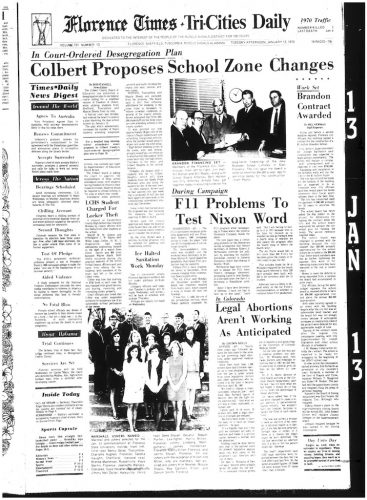
January 13, 1970
Describes the Colbert County Board of Education submitting a desegregation plan to the federal courts system. The plan that was proposed sought to increase the number of black students in white schools. Sheffield, Tuscumbia, and Muscle Shoals are excluded from the zoning divisions. A map is included to show closer detail of the school zoning.